Overview of Childhood Headaches
Headaches in childhood are common and are not usually serious.
The incidence of headaches increases with age (25% of young children and 75% of adolescents). The most common types of headaches in the age between 5-17 years are tension headaches (reported by 15% of children) and migraine (reported by 5% of children). Only less than 3% of headaches are the result of an underlying serious condition.
Definition of Headache
Definition
A headache is pain or discomfort in one or more areas of the head or face. Headaches happen once in a while or they may happen often.
Types of Headaches
Classification of headaches.
- Secondary: They are the result of underlying disease. They are less common.
Common causes
- Common cold
- Viral infections of the upper respiratory tract (influenza A and B)
- Sinusitis
- Toothache
- Acute otitis mecha
Serious causes
- After head injury (intracranial hematoma)
- CNS infection (meningitis or encephalitis)
- Brain tumors (myeloblastoma)
- Rupture of brain aneurysm
- Hypertension in childhood
B. Primary Headaches
They are linked to another health condition. They are usually caused by tight muscles, widened (dilated) blood vessels and changes in nerve signals. They can be hereditary (they occur usually in members of the same family).
The most common types of primary headaches are:
- Tension headaches
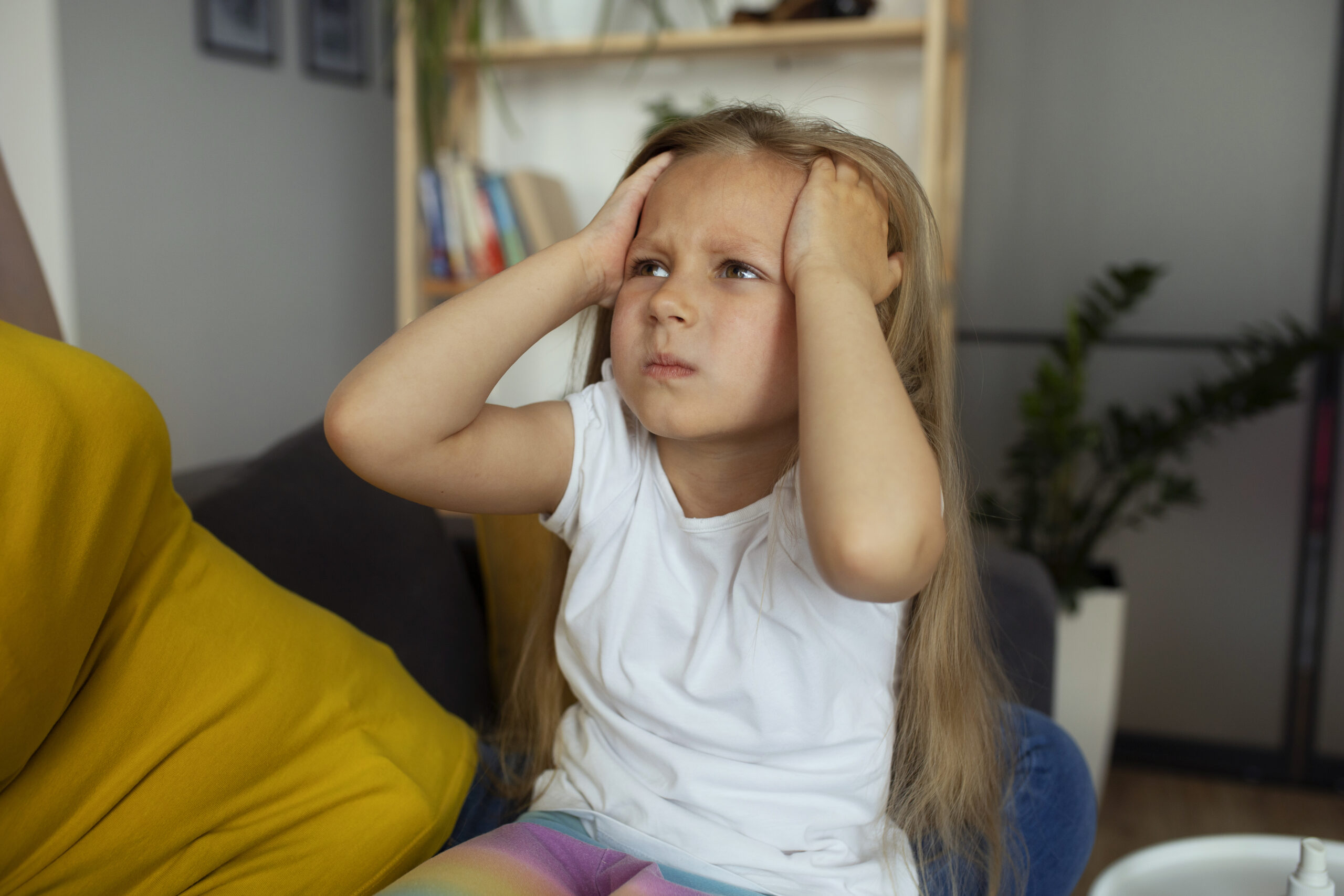
They happen when stressed out head or neck muscles squeeze too hard. This causes pain described as a feeling as though someone is pressing or squeezing on the front, back or both sides of the head. It’s dull and aching constant. Usually it is so strong that it prevents children from participating in their daily activities (for example, going to school).
Types of Tension Headaches
Types of tension headaches
- Episode tension headache (lasts less than 15 days per month)
- Chronic tension headache (lasts more than 15 days per month)
- Chronic non progressive headache (headache that happens daily or few times a month but it does not include the symptoms of migraine)
- Daily tension headache (It happens daily)
Migraine (less common)
It is an escalating pain in intensity, throbbing and pulsating pain on one side of the head or both. It’s usually manifested with nausea, vomiting, dizziness and sensitivity to light and noise. There could be transitory vision disorders (child reports that he sees blackhead and colourful lights).
It’s a strong pain that keeps the child away from his activities.
When to See a Pediatrician
When should your children with a headache see your pediatrician?
If the headache:
- Starts after a head injury
- Wakes them up
- Is sudden and severe and happens with other symptoms such as: vomiting,neck pain or stiffness,double vision or change in vision,confusions ,loss of balance ,fever of 38ºC or more
- If he or she has headache more than once a month
- If he or she is younger than 6 years
- If he or she has a headache and has certain medical conditions such as sickle cell disease, bleeding problems, immune system problem, genetic problems, heart problems or cancer.
7.If there is not a relief after the administration of pain killers.
Management of Headaches
Management of headache
- Secondary headaches
Treatment of an underlying medical condition
- Primary headaches
Non medical care aims at:
- The life style
- Changes and stress management
Lifestyle changes
- Eight hours of sleep every night
- One up to two liters of water daily
- Three healthy meals every day (avoid: caffeine, chocolates, junk food like burger, pizza, sausages, soft drinks, processed food that contain preservative and artificial food colouring)
- Cardio exercise (45 minutes three times a week)
- Relaxation
Stress management
Stress management techniques include:
- Deep breathing exercises
- Meditation
- Music therapy
- Dance
- Reading a book
- Exercise of relaxation techniques every day at least 10 minutes (for example yoga)
Treatment (medicines)
Usual and common pain killers are paracetamol and ibuprofen.
Other long-term treatments for recurrent and chronic treatments are recommended by a doctor after a thorough evaluation of the headache (very good clinical examination and if indicated blood examination, lumbar puncture, CT scan and MRI).
References
References
redflags presental in children complaining of headache-NCBI
uptodate.com
Σημαντική σημείωση
Αυτό το άρθρο παρέχει γενικό εκπαιδευτικό περιεχόμενο. Δεν αντικαθιστά την επίσκεψη στον παιδίατρο ή την εξατομικευμένη ιατρική συμβουλή.
Χρειάζεστε βοήθεια τώρα;
Για επείγοντα συμπτώματα, δυσκολία στην αναπνοή, σοβαρή αντίδραση, μειωμένο επίπεδο συνείδησης ή ραγδαία επιδείνωση, αναζητήστε αμέσως επείγουσα ιατρική φροντίδα.